
Industry Overview
Tutoring covers academic support (K-12 & post-secondary), test prep, language learning, and skills coaching delivered in person or online.
Novantum emphasizes lean, credibility-first models that build recurring weekly sessions over a school year.
Global market size & growth (estimate 1):
The private tutoring market was valued at ~$96B–$100B in 2023 with ~8–9% CAGR through 2030 — Grand View Research.
Global market size & growth (estimate 2):
$123B+ in 2024, projected to $200B+ by early 2030s at ~7–8% CAGR — IMARC Group.
Definition note:
Figures vary by whether sources include test prep, enrichment centers, and online platforms; we present a conservative overlapping range.
Universal Need Justification
- Education is a protected spend. Families consistently prioritize children’s learning; even during economic pressure, education outlays tend to be preserved or reallocated from other categories (OECD Education at a Glance).
- Post-pandemic surge in demand. COVID-19 learning loss created sustained demand for tutoring; multiple systems funded large-scale tutoring as the most effective catch-up lever.
McKinsey (learning loss & need for tutoring), UK National Tutoring Programme (policy response)
- Strong efficacy evidence. High-dosage/small-group tutoring shows significant gains in achievement across meta-analyses and field trials (EEF).
Education Endowment Foundation – Small group tuition
Key Business Economics
Pricing benchmarks (US):
Typical private tutoring rates cluster ~$25–$80/hour, higher for advanced STEM/test prep; small-group formats raise per-hour revenue while keeping per-family cost accessible.
Startup Costs:
Low; often $1k–$5k for registration, insurance, basic materials, and software; no inventory, minimal equipment.
Margin Structure:
Tutoring is labor-driven with very low COGS and modest overhead (software, marketing, compliance), enabling strong contribution margins once weekly rosters are full; recurring school-year contracts stabilize cash flow. (Context on service-business margins and low COGS corroborated across small-business and platform benchmarks above.)
Stability & Growth Factors Novantum Core Criteria
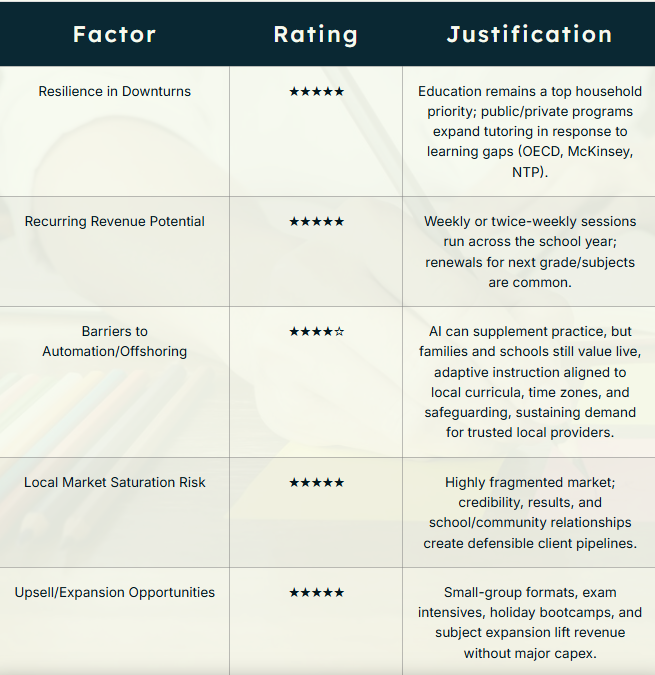
| Factor | Rating | Justification |
|---|---|---|
| Resilience in Downturns | ★★★★★ | Education remains a top household priority; public/private programs expand tutoring in response to learning gaps (OECD, McKinsey, NTP). |
| Recurring Revenue Potential | ★★★★★ | Weekly or twice-weekly sessions run across the school year; renewals for next grade/subjects are common. |
| Barriers to Automation/Offshoring | ★★★★☆ | AI can supplement practice, but families and schools still value live, adaptive instruction aligned to local curricula, time zones, and safeguarding, sustaining demand for trusted local providers. |
| Local Market Saturation Risk | ★★★★★ | Highly fragmented market; credibility, results, and school/community relationships create defensible client pipelines. |
| Upsell/Expansion Opportunities | ★★★★★ | Small-group formats, exam intensives, holiday bootcamps, and subject expansion lift revenue without major capex. |
Why Novantum Chose It
Tutoring aligns perfectly with Novantum’s model: essential demand, recurring weekly revenue, low startup costs, and a premium placed on trust and results, not inventory.
The sector expanded after COVID and continues to grow as families and schools seek proven, human-delivered support.
With Novantum’s tested business models (positioning, school partnerships, group formats, quality controls), founders can build stable, schedule-friendly income that compounds through renewals and referrals.
Ready to Own Your Future?
Apply now to join a high-trust, mentor-backed, revenue-driven co-founder team.
Let us match you with the co-founders, systems, and mentorship designed to get you results.